

VGSO's clients, and through them the Victorian community, are most effectively represented when its legal practitioners reflect the Victorian community. To this end, VGSO has had a long-term commitment to increasing the proportion of women briefed, by both the number and value of briefs. It has delivered on this commitment, growing the proportion of women briefed so that over 50% of its briefs have gone to women in recent years.
VGSO remains committed to the equitable briefing of women. It is also committed to growing the pool of barristers that it briefs so that it reflects other dimensions of the Victorian community. This leadership forms part of VGSO serving the rule of law for the State.
VGSO commits to the actions referred to below.
Actions
Targets for briefing women, broader consideration of who VGSO briefs
VGSO will aim to brief women at a rate of 50% by both the number and monetary value of briefs.
VGSO will also seek to continually grow its pool of barristers so that it includes capable barristers with a broad range of attributes and experience, reflecting the Victorian community. The VGSO will not collect statistics in this area, for privacy considerations, amongst others.
Communicating VGSO's commitment to equitable briefing
The VGSO will seek opportunities to communicate its commitment to equitable briefing to our clients, stakeholders and the broader community. These communications will recognise that gradual progress will lead to meaningful and lasting change through ongoing accountability as an organisation.
Therefore, the VGSO will circulate this Policy annually to its solicitors, paralegals and legal assistants. This updated Equitable Briefing Policy will be available on VGSO's external website and Collaborate. It will also be included in new starter information and referenced in Branch practice notes and discussions about briefing practices.
Including women barristers in briefing shortlists; considering other attributes in forming shortlists
The VGSO's solicitors will ensure that, in preparing briefing shortlists for clients and in seeking recommendations for shortlists, suitably qualified and experienced women barristers are considered. Shortlists should be comprised of 50% female and male barristers. This includes seeking to ensure that at least two women barristers are on a briefing shortlist for teams of four barristers and two to four women for teams of five to eight. VGSO solicitors will also consider whether the people on such shortlists otherwise reflect the diverse nature of the Victorian community.
When the list is prepared, and to ensure that a greater number of women barristers are briefed, lawyers should give genuine consideration to recommending appropriately qualified women barristers. Genuine consideration requires an objective assessment of each barrister's skills, experience, expertise and suitability for the matter.
Recommendations should not be influenced by assumptions, unconscious bias or historical briefing patterns. Where suitably qualified women and men barristers are available, lawyers should ensure women barristers are actively considered and appropriately represented in the options presented to clients.
Identifying new women barristers, otherwise expanding its pool of barristers
The VGSO will proactively identify new women barristers with skills and expertise in the areas in which we regularly brief work out. This may be women who are new to the Bar or women barristers practising in a particular area who were not previously known to the VGSO. This can be achieved by Branches and practice groups:
- continuing to update a Barrister Briefing Database which identifies barristers according to gender, rates, year of admission and signing of the Bar roll, and any relevant expertise and experience
- seeking referrals of women barristers from the clerks of each of the barrister's lists
- where senior counsel is briefed, seeking recommendations for a range of diverse possible junior counsel, including women barristers.
Monitoring and reporting
The VGSO will collect data on the number, and monetary value, of briefs given to female and male barristers, and the level of experience of the barrister briefed. The data will track briefing practices in each Branch and across the organisation.
Data collection should be as specific as possible and track matters by their nature, for example, commercial; administrative law; constitutional law etc.
The VGSO will confidentially report briefing data to the Law Council of Australia. That data will include all engagements of counsel by the VGSO, including those where invoices are paid by VGSO's client directly to the barrister or their clerk.
The VGSO will also report its briefing practices publicly on the external website to promote equitable briefing to the legal profession.
The VGSO will dedicate a section of its external website and Collaborate to its Equitable Briefing Policy and report on its progress on these websites.
Duration and review
This Equitable Briefing Policy will operate on an ongoing basis.
This Policy will be reviewed on a regular basis and, at least, every 12 months.
Implementation
It will be the responsibility of the Office of the Victorian Government Solicitor to review and disseminate this policy.
It will be the Finance Team's responsibility record entries into the database of each invoice received from barristers.
Using data held by the Finance Team, a member of the Office of the VGS will confidentially report briefing data to the Law Council of Australia 12 months. It will be every VGSO solicitor's responsibility to engage counsel in accordance with the Policy.
Evolution of the Equitable Briefing Policy
- In November 2015, the VGSO became a signatory to the Equitable Briefing Initiative of the Commercial Bar Association of Victoria and the Victorian Equal Opportunity and Human Rights Commission. The Equitable Briefing Initiative included a Charter of Commitment that contained six actions to which signatories committed for the period 2016-2019.
- The six actions of which VGSO committed to were aimed at increasing the briefing of women barristers, including setting measurable briefing targets, ensuring women barristers were considered for briefing opportunities, identifying and promoting suitably qualified women barristers, and monitoring and reporting briefing practices. Signatories committed to implementing these actions during the period 2016-2019.
- Following the conclusion of the Equitable Briefing Initiative, the Victorian Charter of Commitment was adopted nationally through the Law Council of Australia's Equitable Briefing Policy, launched on 24 June 2016. The policy encourages briefing entities to take active steps to increase the briefing of women barristers and to monitor and report on briefing practices
- The policy's long-term objective was that women receive at least 30% of all briefs and 30% of the value of all brief fees. These remain the current targets under the 2025 Law Council of Australia policy.
- Under VGSO's 2022 Equitable Briefing Policy, the target was for women barristers to receive at least 40% of briefs, by both number and value. The 2026 policy increases this target to 50% of briefs, by both number and value, reflecting VGSO's commitment to achieving gender parity in briefing practices.
- The 2023 Government Legal Services Panel Deed, required firms to brief or select women barristers for at least 50% of all briefs and at least 50% of the value of all brief fees paid. The same targets are set in the 2026 Amended and Restated Deed. While VGSO is not bound by this requirement in the same way as panel firms, it seeks to achieve the same standards where practical and appropriate to do so.
- Working from the online Victorian Bar directory, at 30 June 2026, there were 2388 practising barristers, 836 female and 1,550 male (35%) (the directory does not have an option to search for barristers who identify as transgender or non-binary). This has increased from 567 female and 1531 male barristers in 2015 (27%) and 700 female and 1521 male in 2022 (32%).
Recent statistics
Nationally
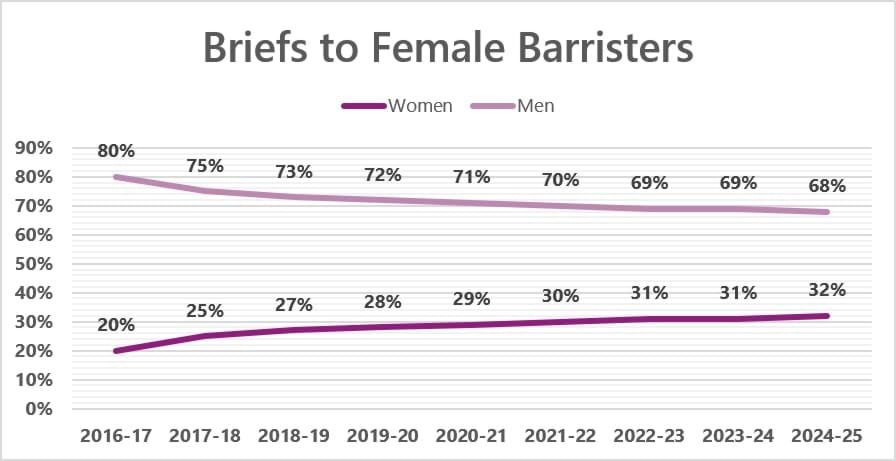
The most recent report of the Law Council of Australia shows that, of the 35,380 total briefs accounted for in the 2024-2025 reporting year, 32% (11,472) went to female barristers and 68% (23,908) went to male barristers. This represents an increase of twelve points since the beginning of the LCA policy in 2016.
As at 2024-25, the LCA policy had been adopted by more than 500 organisations and barristers nationally. During the 2024-25 reporting period, 74 organisations submitting briefing data under the policy.
In terms of fee values, the 74 organisations that reported under the LCA Policy in 2024-25, including government bodies, law firms, corporations and other organisations that regularly engage barristers, reported paying $1,057,080,356 to barristers in the 2024-25 financial year, of which 69% ($731,207,436) went to men, and 31% ($325,872,920) to women. This represents an increase of nine percentage points from the previous reporting year and 16 percentage points since the commencement of the policy.
This is shown in graphical form in Figure 1 and 2 below:
Figure 1: Proportion of total brief fee value paid to women and men barristers (2016-17 to 2024-25)
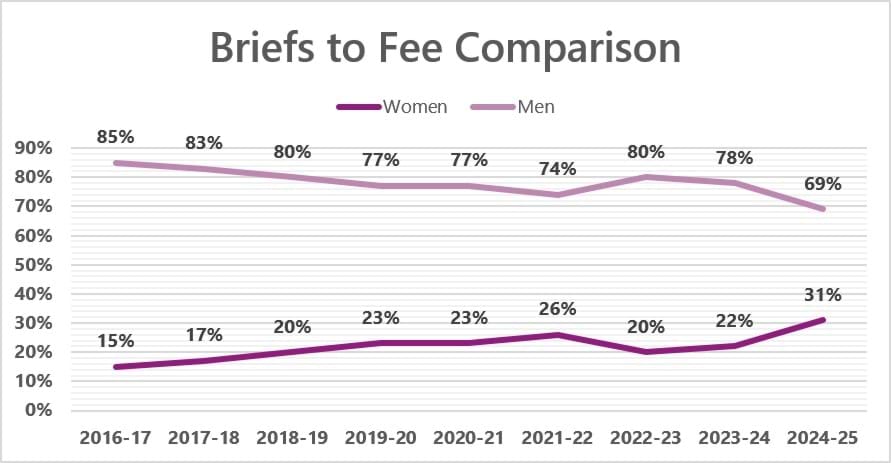
Figure 2: Proportion of briefs awarded to women and men barristers (2016-17 to 2024-25)
At VGSO
In recent reporting periods, VGSO's briefing practices have met or exceeded the targets under the Equitable Briefing Policy, as demonstrated by the following outcomes:
- In 2023-24, women barristers were briefed in 60% of our matters and received 49% of all briefing fees.
- In 2024-25, women barristers were briefed in 55% of our matters and received 51% of all briefing fees.
Download
Updated