

The structure of the Victorian court system
The Victorian court system is structured as a hierarchy and each court has the power to hear matters within its jurisdiction.
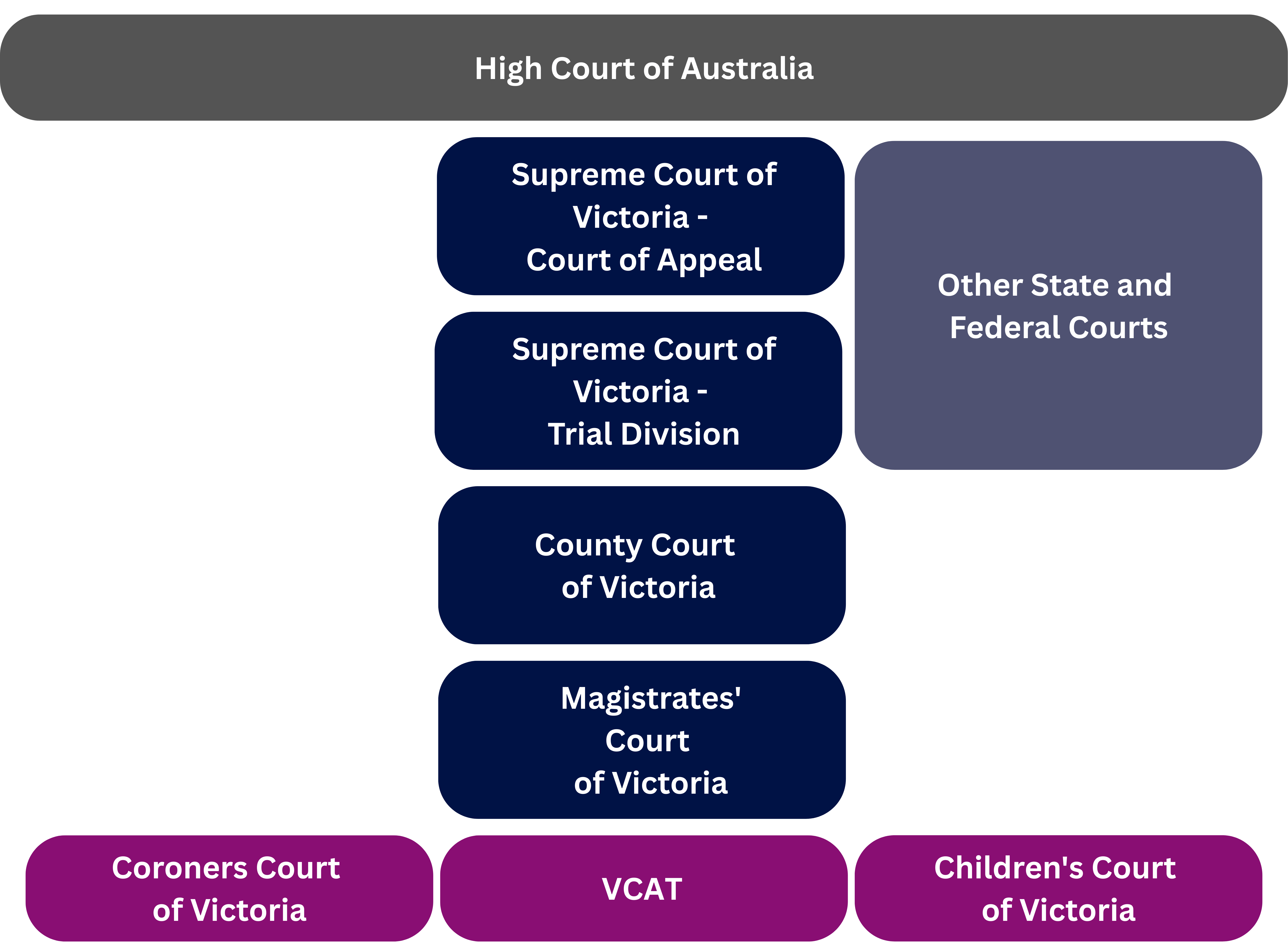
The jurisdiction of the Victorian courts
| Court | Civil jurisdiction | Criminal jurisdiction |
|---|---|---|
| Supreme Court | Monetary limit: Unlimited authority with no monetary cap on damages. Subject matter: The Trial Division hears cases involving:
The Court of Appeal hears appeals from the Trial Division and appeals from other Victorian jurisdictions. | Serious criminal matters |
| County Court | Monetary limit: Unlimited authority with no monetary cap on damages. Subject matter:
| All indictable offences except treason, murder and some very serious offences |
| Magistrates' Court | Monetary limit: Generally speaking, claims up to $100,000 (including personal injury). Subject matter:
(Section 100 of the Magistrates' Court Act 1989) | Summary offences and indictable offences heard summarily |
Cases the Supreme Court of Victoria hears
The Supreme Court is the highest court in Victoria and hears the most complex civil and serious criminal cases in Victoria in either the Trial Division or the Court of Appeal.
Matters heard in the Court of Appeal
The Court of Appeal hears appeals from civil and criminal cases determined in the Trial Division of the Supreme Court, the County Court and some appeals from VCAT, and determines whether a trial was conducted fairly and the law was correctly applied.
Matters heard in the Trial Division of the Supreme Court of Victoria
The Trial Division is made up of 3 divisions:
- The Common Law Division deals with claims in contract law and tort, and is responsible for appeals and reviewing contested decisions from other courts and tribunals.
- The Criminal Division hears the most serious criminal cases in Victoria.
- The Commercial Court determines commercial disputes.
Need more information about the Supreme Court's history, people, work and processes? Listen to the Supreme Court's podcast Gertie's Law.
Cases the County Court of Victoria hears
The County Court is an intermediate trial court in Victoria. It sits above the Magistrates' Court and below the Supreme Court in the Victorian court hierarchy. It is split into 3 divisions:
The Common Law Division
The Division is divided into the following Civil Claims lists:
- Serious Injury
- WorkCover
- Medical
- Institutional Liability
- Defamation
- Family Property
- Adoptions, Surrogacy & Name Changes
- Confiscation
- Appeals and Post Sentence Application
- General
All matters are heard by a single judge or, at the party's request, a judge and jury (a jury of 6 in civil cases).
Note, 'General' covers all other civil claims in the Common Law Division including claims for damages for negligence or an intentional tort that are not included in the Medical List, Institutional Liability List or Defamation List.
The Commercial Division
The Division deals with commercial matters involving issues of debt recovery, contract, trusts and property, and includes the following 5 lists:
- Arbitration
- Banking & Finance
- Building Cases
- Complex Cases
- General
The Criminal Division
This Division hears all criminal matters except treason and murder-related offences, in addition to criminal appeals from the Magistrates' Court. All trials are heard before a judge and jury. Normally 12 jurors are empanelled but this increases to 15 for long trials.
The Koori Court
This court is for people of Aboriginal or Torres Strait Islander descent who are charged with a criminal offence. It encourages the Victorian Aboriginal and Torres Strait Islander communities to participate in the Court's sentencing process. It was established in 2008 and respects Koori cultures and uses less formal processes than other areas of the court. Koori Courts are located in a number of Magistrates' Courts in Victoria.
The Magistrates' court is the first level of the Victorian court system, and handles approximately 90% of legal disputes in Victoria. It sits at 51 different locations in Victoria. Its civil jurisdiction hears matters involving claims in negligence, debt, and other contractual disputes, while its criminal jurisdiction hears and determines a significant number of criminal matters.
The Children's Court specialises in children's matters, and consists of 2 divisions: the Criminal Division and the Family Division.
For a criminal matter to be heard in the Children's Court, the accused must be a "child" within the meaning of the Children, Youth and Families Act 2005 (Vic) - that is, at least 10 and under 18 at the time of the alleged offending, and not 19 or older when the proceeding is commenced.
The Coroners Court is an inquisitorial court - that is, the court is actively involved in investigating the facts of a matter. It is concerned with independently investigating deaths and fires, reducing preventable deaths, and promoting public health and safety and the administration of justice.
VCAT is a tribunal that deals with a wide range of disputes across the areas of civil, administrative, human rights, residential tenancies, and planning and environmental law.
An appeal from a VCAT decision is generally limited to a question of law. Appeals from decisions of a Member, Senior Member or Deputy President are heard in the Trial Division of the Supreme Court. Appeals from decisions of the President or Vice President of the VCAT are heard in the Court of Appeal.
As VCAT is not a court, its jurisdiction is limited to the powers conferred on it by Parliament.
The Financial Assistance Scheme (FAS) provides financial assistance to eligible victims of violent crime committed in Victoria and replaced the Victims of Crime Assistance Tribunal (VOCAT) on 18 November 2024. From the commencement of the FAS, VOCAT is unable to accept new applications, and FAS is responsible for new applications and (relevantly) future-expense and variation requests for finalised VOCAT matters.
They are judges, associate judges, magistrates, judicial registrars, coroners and VCAT members.
Proceedings judicial officers preside over
Directions hearings
A directions hearing is a pre-trial preliminary hearing at which the court checks on the status of a case and makes orders to ensure that it is progressing in a fair and efficient manner. At a directions hearing, the court uses its case management powers to fix timetables for certain steps to be taken or gives directions on how the parties should proceed to resolve certain issues.
Issues dealt with at directions hearings typically include:
- fixing timetables and setting a date for trial
- limiting the time for the hearing by limiting the number of witnesses participating in the hearing
- encouraging parties to participate in alternative dispute resolution.
Interlocutory applications
Interlocutory applications deal with specific issues relating to the management of court cases before a trial commences. Common interlocutory applications include:
- limiting the scope of documents sought to be produced under subpoena
- staying proceedings to prevent further progress
- narrowing the scope of interrogatories
- enforcement of directions due to a party's failure to comply.
Certain interlocutory proceedings can also be used to resolve civil cases without putting the other party to the expense and delay of a full trial. Applications for strike out or summary judgment are useful tools in bringing about a decision prior to trial where a claim or defence has no real prospect of success.
Trial
A trial involves the formal hearing of a case and the main issues in dispute by a judge, jury, or other judicial officer. The conduct of a trial will depend on the issues in dispute and the particular approach the judge wishes to take in managing the proceeding.
A trial will typically involve submissions from each party, witnesses giving evidence and being cross-examined, and closing submissions.
Where a trial is heard by a judge and jury, the judge will also address the jury to summarise the evidence, explain the law presented and give any necessary directions as to how the jury should assess the evidence. The jury or judge will then make a decision about fault and determine the damages (or remedy) to be awarded.
Appeal
An appeal involves a party to a case applying to a superior court to review the original court's decision, and may be made where a party considers that the court has erred in applying the law or deciding the facts of the case. An appeal is not guaranteed in all cases, and a party seeking to appeal a decision may be required to explain the reasons for their appeal via an application for leave to appeal.
Coronial inquests
An inquest is a public hearing into a death or fire. A Coroner must hold an inquest if a person dies (not of natural causes) in custody or care, if a person’s identity is not known or if the Coroner suspects homicide and no one has been charged in relation to the death. A Coroner will usually only decide to hold an inquest if the circumstances surrounding the death or fire are unclear or if there are broader issues of public health and safety that need to be examined.
Judges preside over court proceedings, either alone, as part of a panel, or with a jury in the County and Supreme Courts. As unbiased decision makers, judges:
- provide an impartial and independent assessment of the facts
- interpret the applicable law and apply the law to the facts of a case
- control the conduct of hearings by upholding the court's rules of evidence and procedure.
Associate judges hear and determine issues arising before and after trial in civil cases in the Supreme Court. They are involved in a range of interlocutory disputes and give directions, make orders and deliver judgments on the intermediate stages of proceedings. In addition, they deliver final judgments in certain areas of law.
Associate judges and judicial registrars also preside over court-ordered judicial mediations in the Supreme Court's Mediation Centre.
Magistrates hear cases and make decisions in the Magistrates' Court and Children's Court. They make decisions and give directions about the law and the management of cases, determine civil matters, and decide whether a defendant is guilty or not guilty and impose sentences in criminal matters.
Judicial registrars assist judges, associate judges, and magistrates in managing their workload. They manage administrative and judicial aspects of hearings, and assist in the case management of matters through the pre-trial process. The County Court's judicial registrars also conduct judicial resolution conferences.
Coroners conduct investigations (which can include holding inquests) into reportable deaths and certain fires which have a jurisdictional connection to Victoria. The coroner's role is to find, if possible:
- the identity of the person who died
- the cause of death or fire
- the circumstances surrounding the death or fire.
Where relevant, they also recommend ways that similar deaths and fires can be prevented in the future.
VCAT members have specialist knowledge and qualifications in areas of law heard by VCAT, and adjudicate and resolve matters in a less formal way than the courts.
In the County Court of Victoria and the Supreme Court of Victoria, a civil trial may be held before a judge or a jury as the decision maker in relation to findings of fault and remedies. Trials by jury or judge alone each have their own unique benefits, and require a strategic consideration of the case, particularly where complex issues of evidence or politically sensitive matters are involved. All parties have the right to a jury trial. Where the parties do not agree, and one party wishes to have a jury trial but the other party does not, the party who does not want a trial by jury must persuade the court to allow the trial to be heard by a judge alone.
Court proceedings are largely governed by Acts which specify rules of evidence and procedure. The Civil Procedure Act 2010 governs all civil litigation undertaken in Victoria, prescribes the way in which civil proceedings must be conducted, and facilitates the fair, efficient, timely, and cost-effective resolution of disputes.
Specific Rules of Court also apply to each court, setting out relevant practices and procedures in conducting litigation. For example, the Supreme Court (General Civil(opens in a new window) Procedure) Rules 2025(opens in a new window) mandate a consistent approach to Supreme Court litigation.
Practice notes sit alongside the Rules of Court and provide guidance in relation to the conduct and management of proceedings in particular types of matters. While practice notes are not legally binding, legal practitioners are expected to be familiar with their content and conduct litigation in accordance with their guidance unless directed otherwise.
Where a Victorian Government department or statutory authority is ordered to pay compensation to, or the costs of, another party, it may apply to recover those funds from the State's Consolidated Fund. In order to do so, the State must apply to the relevant court for an order and certificate setting out the amount to be paid, known as a 'Section 26 Certificate' or 'Crown Proceedings Certificate'. Section 26 of the Crown Proceedings Act 1958 (Vic) provides that the Governor may cause money to be paid out of the Consolidated Fund upon receipt of a certificate from the court setting out the sum awarded against the Crown.
Contact
If you are a member of the Victorian Public Sector, please contact our team.
Dominique Mayo
Acting assistant Victorian Government Solicitor
Dominique.Mayo@vgso.vic.gov.au
Sylvia Cecchin
Lead Counsel
Sylvia.Cecchin@vgso.vic.gov.au
Tony Sergi
Lead Counsel
Tony.Sergi@vgso.vic.gov.au
Clytie Shimmin
Lead Counsel
Clytie.Shimmin@vgso.vic.gov.au
With thanks to Alexia Zuccala, Solicitor, for updating the initial version (2020) of this publication.
Updated